Showing posts with label climate change. Show all posts

Monday, February 4, 2008

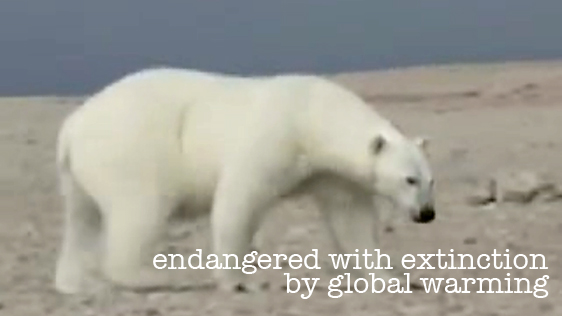
Polar Bear May Be Listed by US as Endangered by Global Warming


The global climate change crisis may soon enter a new phase in terms of human society's reaction, efforts to curb harmful activities that exacerbate the problem. The United States Dept. of the Interior is considering a proposal to list the polar bear as the first species facing extinction specifically as a side-effect of global warming.

The move would fall under the regulatory powers of the Endangered Species Act, and environmental activists believe it could be used as leverage to push for the shutting down of projects that would bring new carbon-emissions-intensive activities (like new coal-fired power plants) into use.

It is not clear that the Endangered Species Act would become a comfortable standard by which to measure the environmental footprint of new industries or specifically new power and chemical plants, but a recent ruling by the US Supreme Court, requiring that the government regulate carbon dioxide as a harmful pollutant, seems to show that the law is moving in that direction.

As the polar bear is dependent on the presence of large chunks of floating sea ice for its seal hunting, the increasing lack of ice in northern summer months has led to speculation the bears' habitat is effectively disappearing. Researchers project that more than two-thirds of the current population could be gone by mid-century.

This particular mega-fauna could be the canary in the coal mine, so to speak, warning of how excess carbon emissions could have a destructive impact on complex habitat around the globe. In the US, environmental activists are suing to get the bear listed as global-warming endangered, and to force coal-fired power plants to produce thorough studies demonstrating how their activities would not negatively impact the bears' habitat, thousands of miles away.

The feeling among many, both in the scientific world and in the regulatory business, is coming around to the view that for too long it was assumed there was no impact, or that the distances are too great to trace such fallout, but that logic is no longer enough. There is evidence of real and traceable impact, and those who seek to capitalize from processes which increase the risk should have to show their plans for how not to.

It may only be now, as policy-making and environmental research begin to converge in a more serious and well-thought-out way, that the standard of sustainable development actually penetrates into the planning process at the federal level. Industrial activities with a high environmental cost may be seen increasingly as not only unfortunate, but beyond the law, where public health and conservation are concerned.

One of the key questions will be, to what degree and how soon to top-level policy-makers integrate the long-term survivability of other species into the planning for a sustainable form of human economic development?

MORE AT
LA Times: "U.S. close to decision on polar bears"
NY Times: "Justices Rule Against Bush Administration on Emissions"

Sunday, December 16, 2007

Overcoming Acrimony, Bali Conference Brings Concessions, Start of a 'Roadmap'

The UN climate change policy conference on the Indonesian island of Bali has ended in dramatic fashion, as EU and US delegates found themselves in a war of words over differences in how to reach long-term reductions in "heat-trapping gases" emitted by human societies, essentially: carbon emissions.

The International Herald Tribune reports on the confrontations and final dealmaking as follows:
In a tumultuous final session at international climate talks in which the U.S. delegates were booed and hissed, delegates from nearly 190 nations committed Saturday to negotiating a new accord by 2009 that, in theory, would set the world on a course toward halving emissions of heat-trapping gases by 2050.

The dramatic finish to the negotiations came after a last-minute standoff during a day of see-saw emotions, with the co-organizer of the conference, Yvo de Boer, fleeing the podium at one point as he held back tears and the representative from Papua New Guinea telling the U.S. delegation to lead, follow or "please get out of the way."

The standoff started when developing countries demanded that the United States agree that the eventual pact not only measure poorer countries' steps, but also the effectiveness of financial aid and technological assistance from wealthier ones.

The United States did capitulate in that open session, which many observers and delegates said included more public acrimony and emotion than any of the treaty conferences since 1992, when countries drafted the original United Nations climate pact, the Framework Convention on Climate Change.

A significant part of the hostility involved in the negotiations has to do with mounting evidence that climate change is not only accelerating, but that it will adversely affect certain poorer countries more than the wealthy industrialized nations or fast-growing developing nations (like India or China) blamed for the lion's share of the greenhouse-effect-related emissions.

The current US position, which differs from what Democratic leaders in Congress have suggested might be an alternative policy in coming administrations, is in part based on the economic analysis that aggressive efforts to enforce emissions reductions would slow or even reverse economic growth in coming years. Part of this analysis is a lack of planning for a broad industrial reorganization, which would imply millions of new jobs, increasingly dynamic new economic structures, and the ability to meet ever-more-costly energy needs afffordably for the average consumer.

Over the long term, it will benefit wealthy economies to lead not only in emissions regulations but also in the shift to incentivized clean energy technologies. Cooperating with the plans for a global emissions regime and working strict standards into the policy guidelines will help ensure that developing nations are not able to fall back on high-contamination production methods to achieve unsustainable levels of short-term growth.

An integrated policy direction among developed and developing nations will help ensure that 'seepage' of policy direction toward apparently cheap but economically adverse polluting production methods not undermine the capacity for international regulations to reduce the risk of damaging climate change. This will benefit all parties economically over the long-term, though short-term considerations continue to drive much of the policy of major players.

Sunday, November 18, 2007

The Time is Now, an Action Plan for Global Emissions Reduction


Due to the science we already have, the laws we have to govern our own activity and to force government to act for the public health, we face the real possibility of being forced, in American courts, in the future, to pay for damage done to the most affected populations in other parts of the world, as a result of inaction by our government. And if not in court, then as a matter of the de facto urgencies of international political stability.

If we do not find a way to work to mitigate global climate change, future generations will look back and will see clearly that a zeitgeist of selfish convenience and primitive disregard for the wellbeing of our fellow human beings led to a reckless attitude with regard to this snowballing crisis. The public voice, and those campaigning for the level of public respect needed for election to office, should bring this issue to the fore, push for real initiatives to tackle the problem boldly, in a collaborative way, now.

In November, UN secretary general Ban Ki-moon wrote a piece entitled "At the tipping point", in which he explained some of the most dire aspects of the advancing effects of global climate change. Among the serious potential crises is the evidence that 20% of of Antarctica's territory, in the form of the West Antarctic Ice Sheet, may break up. "If it broke up, sea levels could rise by six meters", he writes.

Added to that, such massive events may take some time to unfold, but once they reach their respective tipping point, the event itself could happen "quickly, almost overnight". It's worth considering what effect such a sudden sea-level rise would have on low-lying coastal cities, like New York, Mumbai or Shanghai, Dubai, Sydney or Hong Kong. The storm surge that breached New Orleans' levees and plunged the city into chaos was roughly six meters.

The IPCC is one of the most comprehensive and prestigious bodies of scientists ever gathered from around the world, and it has been unequivocal in its reports this year. Every major player in world politics, including Pres. Bush, has acknowledged that global climate change is happening, and is the result of human activities. 2007 will be remembered as the year the climate crisis went public and stayed on the global public interest radar, for good. The United States cannot afford to be lagging behind, not now, and not in the eyes of history.

Senator Barack Obama's campaign website explains the problem as follows: "Global warming is real, is happening now and is the result of human activities. The number of Category 4 and 5 hurricanes has almost doubled in the last 30 years. Glaciers are melting faster; the polar ice caps are shrinking; trees are blooming earlier; oceans are becoming more acidic, threatening marine life; people are dying in heat waves; species are migrating, and eventually many will become extinct." In fact, large-scale mass extinction already appears to be underway, with the IPCC predicting 15% to 37% of all species may be wiped out by climate change alone.

The campaign issue write-up continues: "Scientists predict that absent major emission reductions, climate change will worsen famine and drought in some of the poorest places in the world and wreak havoc across the globe. In the U.S., sea-level rise threatens to cause massive economic and ecological damage to our populated coastal areas." Many may disagree, but the science supports every word of the problem as stated. US presidential candidates are, for the first time, seriously contending for the climate-responsibility prize.

So, for those candidates serious enough to work across ideological rifts, a proposal for responsible legislation to deal with this crisis (to be pushed for and initiated in advance of the November 2008 US elections):

1. Push a 90% emissions reduction goal for 2050, and make it global. (There's no reason this cannot be done. Wind-energy resources in Texas, Kansas and North Dakota alone could power the entire US economy and more, if properly funded and developed. Most nations have a surplus of wind resources; the secret is local development and responsible construction and implementation. Other new technologies and a rebuilding of transport infrastructure can help reach this goal, without undermining economic stability.)

2. Work to punish all forms of corruption associated with energy production, and implement stiff sanctions against any nation that does not severely punish such corruption (whether it's bribery is Appalachian coal mining schemes, Saudi authoritarianism and arms trafficking, Uzbekistan's megalomaniac leader, or China's support for the Bashir government in Khartoum).

3. Ensure that the US economy is incentivized, from top to bottom, to adopt renewable resources and that we can fund through innovation, entrepreneurship, research and development grants, the green technology boom, which if properly carried out, will far surpass the 1990s economic expansion related to the building and popularization of the world wide web.

4. Institute in US law a "limited use" doctrine for nuclear plants, which means they will be employed in a period of transition (with no new construction) as a means of softening the price pinch that could come to sectors that lag in the renewables transition. This is not meant to allow new growth or prolonged use of fossil fuels, but rather to avoid punishing the underprivileged for their lack of access to easy capital. Eventually, a plan will need to be implemented that will transition away from these extremely costly plants with unequaled capacity for contamination (in case of accident).

5. Greening the military: begin immediately the funding and incentivization for defense contractors of a comprehensive transition to a military made more efficient, flexible and green in its global reach by way of the ecological (which in the very near future means economic) sustainability of its technologies and deployment systems. This will soon be a measure of rapid-deployment capacity, i.e. the ability to project power without bankrupting the state, so there is a direct security motivation involved in this. (The US military is a massive source of research and development, and cutting-edge technologies could emerge for civilian use, if the fossil fuel addiction is broken.)

6. Plan for "jump" generation innovations: energy resourcing is still in its infancy, comparatively (fossil fuels are square one; nuclear a bold but ill-advised 'spur'; renewables are the first step toward rational sustainable energy policy; after renewables, or within the context of, there will come a more advanced mode of powering the global economy). Geothermal still relies on risky construction methods, wind requires massive construction and solar occupies space (ever less, but still a constraint), whereas new capabilities may be lying in wait beyond the scope of current scientific methods.

Let's think ahead and privilege the "zero emissions" criterion. The more we can do to implement large-scale energy solutions that are in themselves zero-emissions processes, the larger the percentage of current emissions we can do without. It's that simple.

We are on the cusp of an energy revolution, which is synonymous with acting to save the relative homeostasis of the global environment, to which our civilization is accustomed and which it requires for long-term stability. We can phase out fossil fuels, then nuclear, while building a global renewables grid, and (parallel to that) jumping ahead to what's next. Integrated thinking will help us to serve the needs of a global systems ecology imperiled by our current practices.

Lastly, I propose that it is of the utmost urgency to examine security risks involved with climate change. We already have water wars in Africa. There are potential hydrological conflicts brewing in South America and south Asia. Australia faces the possibility of the Sydney region becoming near uninhabitable in a century's time. And Bangladesh, with more than 150 million inhabitants, is caught between India's overpumping of vital rivers and the constant threat of mass death and chaos from monsoon flooding.

We need to look at the potential for crop failure on massive regional scales, resulting economic or political collapse, or the unplanned migration of tens of millions of refugees, and what happens when local militia start responding (reference: Darfur, or Afghanistan, on a much larger scale).

We need to find a collaborative framework wherein:
1. democracy is not in any way curtailed nor are totalitarian measures elevated by the global protocols;
2. global treaties are bold, viable, respected and implemented;
3. the median wealth of the human population globally is increased (to de-incentivize violations).

This is the very least we can do to get started.

Sunday, October 14, 2007

Nobel Peace Prize Awarded for Work to Raise Awareness About Global Climate Change


Sentido.tv :: Climate change is no longer controversial; it has been accepted as scientific fact by a global consensus of researchers and policy makers, including the Bush White House, which resisted acknowledging human activities were a vital contributing factor, until recently. Now the Nobel committee selecting the Peace Prize laureate has raised the issue of warming posing a major international security crisis.

At a September conference he hosted on 'Energy Security and Climate Change', Pres. Bush acknowledged the validity of the IPCC's research, stating "A report issued earlier this year by the U.N. Intergovernmental Panel on Climate Change concluded both that global temperatures are rising and that this is caused largely by human activities. When we burn fossil fuels we release greenhouse gases into the atmosphere, and the concentration of greenhouse gases has increased substantially."

And now, the political class in the US liberal-conservative hot-bed must grapple with the fact that climate change will be, when its most serious repercussions are felt, an international security issue, pushing millions of refugees across borders in search of basic sustenance, like water and food. And policy-makers in the US must come to terms with their very real role in shaping the global capacity to confront these adverse consequences.

The Sudan is cited as a first-case. It's long civil war, in which the Khartoum-based regime fought against rebellions in the east, south and west of the country, had a lot to do with food and water scarcity, and the need to control natural resources like oil in order to have the wealth to import sufficient amounts of those vital commodities or to build needed irrigation. Khartoum would not allow local control in any part of the country. Further desertification, the "advance of the Sahara", threatens to return Sudan to multi-party civil war.

More global cases involve countries like China, India and Pakistan, three nuclear powers, which could find themselves engaged in a brutal life and death struggle to provide water to their immense populations, as snow-melt from the Himalayan Plateau becomes scarce. The world cannot afford to allow such a war, or its causes, to burst forth.

The IPCC, which shares the award with Mr. Gore, the world's most visible climate campaigner, has issued several reports this year alone putting top-line consensus climate science into the public domain and forcing governments to keep dealing with the issue publicly and diplomatically. [Complete Text]