Showing posts with label policy-making. Show all posts

Saturday, March 29, 2008

Nuclear Material Found in Andes Sign of Proliferation Threat

Reports out of Colombia cite government sources saying the FARC (Fuerzas Armadas Revolucionarias de Colombia) acquired uranium on the black market. Colombian authorities claim to have recoverd 66 pounds of uranium. The radioactive material, which in some forms can fuel to a nuclear device, was said to have been recovered after information on 3 laptops seized led authorities to it.

Colombian officials had said previously that they suspected the FARC were trying to acquire nuclear material in order to make a radioactive "dirty bomb", but that has yet to be confirmed. According to reports about the actual find, the material may have been purchased for resale, as a means of generating revenue or aiding other militant groups.

The Seattle Times reports:
The two uranium chunks found Wednesday were described by Colombia's military chief as "impoverished." Only uranium enriched through processing - something most countries, including Colombia, are not equipped to do - can be used to make nuclear weapons or power reactors, scientists say.

While independent confirmation of the recovered material or its origin is not available, the meaning of loose nuclear material traveling through the Andean region on the black market, is a sign of the real risks of proliferation. It is not merely international conflict or state-funded arms races that promote nuclear proliferation; there is also the element tied to the financial interests of smaller players, some of whom may be involved in armed conflict with their nation's government.

This is a wildly different vision of the WMD threat from what was professed so voluminously in the run-up to the Iraq war in 2003. "Rogue states" seeking nuclear material from established market providers is a much lower threat, due to the level of oversight, international regulation and foreign management of the resources. The Andean material hints at a network of vendors not answering to governments or to regulatory regimes.

Whether or not this material was intended to be used in a "dirty bomb", or for resale to a shadowy entity seeking to do research, its being loose is itself a threat to public safety, and a sign of ineffectual international regulation. Whether or not Colombia will be able to determine the actual origin of the seized uranium, these reports raise the question as to what sort of diplomatic initiatives would best work to curb the spread of catalytic nuclear materials.

WISE Uranium reports that at least 4 different corporations are conducting new uranium mining exploration projects inside Colombia. So, Colombia itself is a possible source for the materials.

Policy approaches to such incidents must balance the temptation to forceful or coercive responses with a genuine examination of the root causes and the actual security flaws. Overreaching will only worsen the problem. At present, the FARC is reported to refute the authenticity of the laptops, saying they could not have survived Colombia's bombardment of their camp.

Friday, March 28, 2008

Moving Down the Food Chain

Lester Brown's latest book is on sale in bookstores and at Earth-Policy.org, and can be read in full online there, free of charge.EXCERPT FROM PLAN B 3.0, CH. 9: "FEEDING 8 BILLION WELL"

Lester Brown, EPI :: One of the questions I am most often asked is, “How many peo-ple can the earth support?” I answer with another question: “Atwhat level of food consumption?” Using round numbers, at theU.S. level of 800 kilograms of grain per person annually for food and feed, the 2-billion-ton annual world harvest of grain would support 2.5 billion people. At the Italian level of consumption of close to 400 kilograms, the current harvest would support 5 billion people. At the 200 kilograms of grain consumed by the average Indian, it would support a population of 10 billion.

In every society where incomes rise, people move up the food chain, eating more animal protein as beef, pork, poultry, milk, eggs, and seafood. The mix of animal products varies with geography and culture, but the shift to more livestock products as purchasing power increases appears to be universal. As consumption of livestock products, poultry, and farmed fish rises, grain use per person also rises. Of the roughly 800 kilograms of grain consumed per person each year in the United States, about 100 kilograms is eaten directly as bread, pasta, and breakfast cereals, while the bulk of the grain is consumed indirectly in the form of livestock and poultry products. By contrast, in India, where people consume just under 200 kilograms of grain per year, or roughly a pound per day, nearly all grain is eaten directly to satisfy basic food energy needs. Little is available for conversion into livestock products.

Of the three countries just cited, life expectancy is highest in Italy even though U.S. medical expenditures per person are much higher. People who live very low or very high on the food chain do not live as long as those in an intermediate position. Those consuming a Mediterranean type diet that includes meat, cheese, and seafood, but all in moderation, are healthier and live longer. People living high on the food chain, such as Americans or Canadians, can improve their health by moving down the food chain. For those who live in low-income countries like India, where a starchy staple such as rice can supply 60 percent or more of total caloric intake, eating more protein-rich foods can improve health and raise life expectancy.

In agriculture we often look at how climate affects the food supply but not at how what we eat affects climate. While we understand rather well the link between climate change and the fuel efficiency of the cars we buy, we do not have a comparable understanding of the climate effect of various dietary options. Gidon Eshel and Pamela A. Martin of the University of Chicago have addressed this issue. They begin by noting that the energy used in the food economy to provide the typical American diet and that used for personal transportation are roughly the same. In fact, the range between the more and less carbon-intensive transportation options and dietary options is each about 4 to 1. With cars, the Toyota Prius, a gas-electric hybrid, uses scarcely one fourth as much fuel as a Chevrolet Suburban SUV. Similarly with diets, a plant-based diet requires roughly one fourth as much energy as a diet rich in red meat. Shifting from a diet rich in red meat to a plant-based diet cuts greenhouse gas emissions as much as shifting from a Suburban SUV to a Prius.

The inclusion of soybean meal in feed rations to convert grain into animal protein more efficiently, the shift by consumers to more grain-efficient forms of animal protein, and the movement of consumers down the food chain all can help reduce the demand for land, water, and fertilizer. This reduces carbon emissions and thus helps to stabilize climate as well.

Sunday, March 23, 2008

FOOD SUPPLY RESTORATION & SECURITY: AFRICA


As part of the Crisis Policy Forum, the HotSpring collaborative innovation initiative is now planning an effort to tackle the problem of food supply management and chronic food and water scarcity in Africa. The lessons from this experiment in collaborative research will be applicable in many cases to other situations around the world, and we are open to spurring dialogue in those areas as outgrowths of this ongoing discussion.

Among the basic problems we now face, as a species, is the confluence of difficulties in providing reliable clean drinking water reserves, a viable and sustainable food web, by way of an integrated agricultural and distribution ecosystem, economic stability and cohesive political engagement within a defensible political framework.

Ethnic rivalries, resource-focused regional proxy wars, like the massive decade-long tragedy in DR Congo (in which as many as 14 states played a role), and political manipulations and their fallout, as we have seen in Kenya this winter, threaten to further undermine production and distribution systems.

Add to such conflicts the tens of millions of fatal cases of HIV infection, and we have a crisis of historic proportions where mass peril will drive political structures, borders and aspirations on an unprecedented scale. Small-scale logical enhancements to political and economic stability, democratization and integrated decentralization of administrative resources, are needed to reduce risk of mass starvation and heal mounting tensions.

Discussion is now open: please comment below. We would like to focus on practical solutions to:
  1. Problems related to infusing food supply with enough to feed all those in need;
  2. Environmental degradation: i.e. resilience services, ecological measures, ecosystem management;
  3. Land use deficiencies: how to improve;
  4. Animal and timber poaching;
  5. Economic corrosion and instability;
  6. Corruption and funding shortfalls;
  7. Cooperative measures for extending food supply to conflict-afflicted areas;
  8. Overcoming limits of transportation infrastructure;
  9. Contagious disease: treatment, education, socio-economic impact;
  10. Communications gaps: get relevant anecdotal and researched data to those who can use it.

Monday, March 17, 2008

Witness.org Brings Truth of Human Rights Abuse to the Eyes of the World


A revolutionary web-based social networking project, Witness.org has created a platform for delivering evidentiary video documenting human rights abuses for the collective conscience of the online world. 'The Hub', as the video sharing platform is called, is designed to ensure that individuals who have documented potential human rights abuses, or who are able to give their testimony via video, can put their message before the eyes of the world.

Begun in 1992, after a number of prominent occasions made it clear that video evidence made it far more difficult to obscure brutal acts of state violence (namely Tiananmen Square, and in an American media phenomenon, the Rodney King tape), Witness was started as an organization whose mission was to find documentary evidence and make it available, in the interests of promoting human rights and righting injustices.

The Hub is now providing select human rights activists with pocket-sized digital video cameras, in hopes they can gather interviews from witnesses to human rights abuses around the world, and begin creating a video archive of testimony from those who know and those who can help to motivate change and spur public opinion abroad to take an interst in specific crises, like those in Darfur, Burma or the Democratic Republic of Congo.

Witness has helped to bring abourt awareness of abuses in Darfur, Chechnya, Burma, and many other places, as well as focusing on the plight of the most ignored victims of mass tragedy: internally displaced people (IDP), refugees who remain within the borders of a war-torn country with a totalitarian or ethnically repressive regime, or which is subject to a state of continual anarchy and bloodshed.

Monday, February 4, 2008

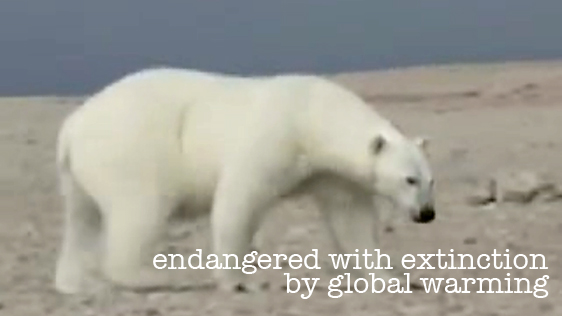
Polar Bear May Be Listed by US as Endangered by Global Warming


The global climate change crisis may soon enter a new phase in terms of human society's reaction, efforts to curb harmful activities that exacerbate the problem. The United States Dept. of the Interior is considering a proposal to list the polar bear as the first species facing extinction specifically as a side-effect of global warming.

The move would fall under the regulatory powers of the Endangered Species Act, and environmental activists believe it could be used as leverage to push for the shutting down of projects that would bring new carbon-emissions-intensive activities (like new coal-fired power plants) into use.

It is not clear that the Endangered Species Act would become a comfortable standard by which to measure the environmental footprint of new industries or specifically new power and chemical plants, but a recent ruling by the US Supreme Court, requiring that the government regulate carbon dioxide as a harmful pollutant, seems to show that the law is moving in that direction.

As the polar bear is dependent on the presence of large chunks of floating sea ice for its seal hunting, the increasing lack of ice in northern summer months has led to speculation the bears' habitat is effectively disappearing. Researchers project that more than two-thirds of the current population could be gone by mid-century.

This particular mega-fauna could be the canary in the coal mine, so to speak, warning of how excess carbon emissions could have a destructive impact on complex habitat around the globe. In the US, environmental activists are suing to get the bear listed as global-warming endangered, and to force coal-fired power plants to produce thorough studies demonstrating how their activities would not negatively impact the bears' habitat, thousands of miles away.

The feeling among many, both in the scientific world and in the regulatory business, is coming around to the view that for too long it was assumed there was no impact, or that the distances are too great to trace such fallout, but that logic is no longer enough. There is evidence of real and traceable impact, and those who seek to capitalize from processes which increase the risk should have to show their plans for how not to.

It may only be now, as policy-making and environmental research begin to converge in a more serious and well-thought-out way, that the standard of sustainable development actually penetrates into the planning process at the federal level. Industrial activities with a high environmental cost may be seen increasingly as not only unfortunate, but beyond the law, where public health and conservation are concerned.

One of the key questions will be, to what degree and how soon to top-level policy-makers integrate the long-term survivability of other species into the planning for a sustainable form of human economic development?

MORE AT
LA Times: "U.S. close to decision on polar bears"
NY Times: "Justices Rule Against Bush Administration on Emissions"

Sunday, December 16, 2007

Overcoming Acrimony, Bali Conference Brings Concessions, Start of a 'Roadmap'

The UN climate change policy conference on the Indonesian island of Bali has ended in dramatic fashion, as EU and US delegates found themselves in a war of words over differences in how to reach long-term reductions in "heat-trapping gases" emitted by human societies, essentially: carbon emissions.

The International Herald Tribune reports on the confrontations and final dealmaking as follows:
In a tumultuous final session at international climate talks in which the U.S. delegates were booed and hissed, delegates from nearly 190 nations committed Saturday to negotiating a new accord by 2009 that, in theory, would set the world on a course toward halving emissions of heat-trapping gases by 2050.

The dramatic finish to the negotiations came after a last-minute standoff during a day of see-saw emotions, with the co-organizer of the conference, Yvo de Boer, fleeing the podium at one point as he held back tears and the representative from Papua New Guinea telling the U.S. delegation to lead, follow or "please get out of the way."

The standoff started when developing countries demanded that the United States agree that the eventual pact not only measure poorer countries' steps, but also the effectiveness of financial aid and technological assistance from wealthier ones.

The United States did capitulate in that open session, which many observers and delegates said included more public acrimony and emotion than any of the treaty conferences since 1992, when countries drafted the original United Nations climate pact, the Framework Convention on Climate Change.

A significant part of the hostility involved in the negotiations has to do with mounting evidence that climate change is not only accelerating, but that it will adversely affect certain poorer countries more than the wealthy industrialized nations or fast-growing developing nations (like India or China) blamed for the lion's share of the greenhouse-effect-related emissions.

The current US position, which differs from what Democratic leaders in Congress have suggested might be an alternative policy in coming administrations, is in part based on the economic analysis that aggressive efforts to enforce emissions reductions would slow or even reverse economic growth in coming years. Part of this analysis is a lack of planning for a broad industrial reorganization, which would imply millions of new jobs, increasingly dynamic new economic structures, and the ability to meet ever-more-costly energy needs afffordably for the average consumer.

Over the long term, it will benefit wealthy economies to lead not only in emissions regulations but also in the shift to incentivized clean energy technologies. Cooperating with the plans for a global emissions regime and working strict standards into the policy guidelines will help ensure that developing nations are not able to fall back on high-contamination production methods to achieve unsustainable levels of short-term growth.

An integrated policy direction among developed and developing nations will help ensure that 'seepage' of policy direction toward apparently cheap but economically adverse polluting production methods not undermine the capacity for international regulations to reduce the risk of damaging climate change. This will benefit all parties economically over the long-term, though short-term considerations continue to drive much of the policy of major players.

Sunday, November 18, 2007

The Time is Now, an Action Plan for Global Emissions Reduction


Due to the science we already have, the laws we have to govern our own activity and to force government to act for the public health, we face the real possibility of being forced, in American courts, in the future, to pay for damage done to the most affected populations in other parts of the world, as a result of inaction by our government. And if not in court, then as a matter of the de facto urgencies of international political stability.

If we do not find a way to work to mitigate global climate change, future generations will look back and will see clearly that a zeitgeist of selfish convenience and primitive disregard for the wellbeing of our fellow human beings led to a reckless attitude with regard to this snowballing crisis. The public voice, and those campaigning for the level of public respect needed for election to office, should bring this issue to the fore, push for real initiatives to tackle the problem boldly, in a collaborative way, now.

In November, UN secretary general Ban Ki-moon wrote a piece entitled "At the tipping point", in which he explained some of the most dire aspects of the advancing effects of global climate change. Among the serious potential crises is the evidence that 20% of of Antarctica's territory, in the form of the West Antarctic Ice Sheet, may break up. "If it broke up, sea levels could rise by six meters", he writes.

Added to that, such massive events may take some time to unfold, but once they reach their respective tipping point, the event itself could happen "quickly, almost overnight". It's worth considering what effect such a sudden sea-level rise would have on low-lying coastal cities, like New York, Mumbai or Shanghai, Dubai, Sydney or Hong Kong. The storm surge that breached New Orleans' levees and plunged the city into chaos was roughly six meters.

The IPCC is one of the most comprehensive and prestigious bodies of scientists ever gathered from around the world, and it has been unequivocal in its reports this year. Every major player in world politics, including Pres. Bush, has acknowledged that global climate change is happening, and is the result of human activities. 2007 will be remembered as the year the climate crisis went public and stayed on the global public interest radar, for good. The United States cannot afford to be lagging behind, not now, and not in the eyes of history.

Senator Barack Obama's campaign website explains the problem as follows: "Global warming is real, is happening now and is the result of human activities. The number of Category 4 and 5 hurricanes has almost doubled in the last 30 years. Glaciers are melting faster; the polar ice caps are shrinking; trees are blooming earlier; oceans are becoming more acidic, threatening marine life; people are dying in heat waves; species are migrating, and eventually many will become extinct." In fact, large-scale mass extinction already appears to be underway, with the IPCC predicting 15% to 37% of all species may be wiped out by climate change alone.

The campaign issue write-up continues: "Scientists predict that absent major emission reductions, climate change will worsen famine and drought in some of the poorest places in the world and wreak havoc across the globe. In the U.S., sea-level rise threatens to cause massive economic and ecological damage to our populated coastal areas." Many may disagree, but the science supports every word of the problem as stated. US presidential candidates are, for the first time, seriously contending for the climate-responsibility prize.

So, for those candidates serious enough to work across ideological rifts, a proposal for responsible legislation to deal with this crisis (to be pushed for and initiated in advance of the November 2008 US elections):

1. Push a 90% emissions reduction goal for 2050, and make it global. (There's no reason this cannot be done. Wind-energy resources in Texas, Kansas and North Dakota alone could power the entire US economy and more, if properly funded and developed. Most nations have a surplus of wind resources; the secret is local development and responsible construction and implementation. Other new technologies and a rebuilding of transport infrastructure can help reach this goal, without undermining economic stability.)

2. Work to punish all forms of corruption associated with energy production, and implement stiff sanctions against any nation that does not severely punish such corruption (whether it's bribery is Appalachian coal mining schemes, Saudi authoritarianism and arms trafficking, Uzbekistan's megalomaniac leader, or China's support for the Bashir government in Khartoum).

3. Ensure that the US economy is incentivized, from top to bottom, to adopt renewable resources and that we can fund through innovation, entrepreneurship, research and development grants, the green technology boom, which if properly carried out, will far surpass the 1990s economic expansion related to the building and popularization of the world wide web.

4. Institute in US law a "limited use" doctrine for nuclear plants, which means they will be employed in a period of transition (with no new construction) as a means of softening the price pinch that could come to sectors that lag in the renewables transition. This is not meant to allow new growth or prolonged use of fossil fuels, but rather to avoid punishing the underprivileged for their lack of access to easy capital. Eventually, a plan will need to be implemented that will transition away from these extremely costly plants with unequaled capacity for contamination (in case of accident).

5. Greening the military: begin immediately the funding and incentivization for defense contractors of a comprehensive transition to a military made more efficient, flexible and green in its global reach by way of the ecological (which in the very near future means economic) sustainability of its technologies and deployment systems. This will soon be a measure of rapid-deployment capacity, i.e. the ability to project power without bankrupting the state, so there is a direct security motivation involved in this. (The US military is a massive source of research and development, and cutting-edge technologies could emerge for civilian use, if the fossil fuel addiction is broken.)

6. Plan for "jump" generation innovations: energy resourcing is still in its infancy, comparatively (fossil fuels are square one; nuclear a bold but ill-advised 'spur'; renewables are the first step toward rational sustainable energy policy; after renewables, or within the context of, there will come a more advanced mode of powering the global economy). Geothermal still relies on risky construction methods, wind requires massive construction and solar occupies space (ever less, but still a constraint), whereas new capabilities may be lying in wait beyond the scope of current scientific methods.

Let's think ahead and privilege the "zero emissions" criterion. The more we can do to implement large-scale energy solutions that are in themselves zero-emissions processes, the larger the percentage of current emissions we can do without. It's that simple.

We are on the cusp of an energy revolution, which is synonymous with acting to save the relative homeostasis of the global environment, to which our civilization is accustomed and which it requires for long-term stability. We can phase out fossil fuels, then nuclear, while building a global renewables grid, and (parallel to that) jumping ahead to what's next. Integrated thinking will help us to serve the needs of a global systems ecology imperiled by our current practices.

Lastly, I propose that it is of the utmost urgency to examine security risks involved with climate change. We already have water wars in Africa. There are potential hydrological conflicts brewing in South America and south Asia. Australia faces the possibility of the Sydney region becoming near uninhabitable in a century's time. And Bangladesh, with more than 150 million inhabitants, is caught between India's overpumping of vital rivers and the constant threat of mass death and chaos from monsoon flooding.

We need to look at the potential for crop failure on massive regional scales, resulting economic or political collapse, or the unplanned migration of tens of millions of refugees, and what happens when local militia start responding (reference: Darfur, or Afghanistan, on a much larger scale).

We need to find a collaborative framework wherein:
1. democracy is not in any way curtailed nor are totalitarian measures elevated by the global protocols;
2. global treaties are bold, viable, respected and implemented;
3. the median wealth of the human population globally is increased (to de-incentivize violations).

This is the very least we can do to get started.

Sunday, September 30, 2007

The Elders Initiative, an Effort to Infuse Wisdom into Global Policy & Conflict Resolution


The Elders is a humanitarian initiative led by South African archibishop Desmond Tutu and former South African pres. Nelson Mandela, designed to bring the African "village elders" concept to the global village, in an effort to defuse flashpoint crisis situations and speed responsible policy-making. Its foundations are the basic principles of human rights and the experience and credibility of the group's emissaries.

Apart from Mandela and Tutu, the group also includes Mandela's wife Graça Machel, Kofi Annan, Lakhtar Brahimi, fmr. US pres. Jimmy Carter, Ela Bhatt, Gro Brundtland, Fernando Cardoso, Li Zhaoxing, Mary Robinson and Muhammad Yunus, founder of the Nobel laureate Grameen Bank for microcredit.

The stature of those included is part of what is expected to bring an international diplomatic prestige to its chosen approach to select humanitarian causes and conflict resolution. The Elders have said they reserve a place for detained Burmese opposition leader Aung San Suu Kyi. The idea was originally brought to Mandela seven years ago by British billionaire and philanthropist Richard Branson.

Nelson Mandela, in his inaugural address to announce the group's founding, said:
"As institutions of government grapple, often unequally, with challenges they face, the efforts of a small, dedicated group of leaders, working objectively and without any vested interest in the outcome, can help resolve what often seem like intractable problems ... Using their collective experience, their moral courage and their ability to rise above the parochial concerns of nation, race and creed, they can help to make our planet a more peaceful, healthy and equitable place to live."

He added that the group will not become "arbitrary and arrogant" and will seek "long-term, sustainable approaches", based on the advice of local interests, scientific experts, political advisors and "anyone who is motivated to help resolve a problem".

The group's first mission will be to Sudan, in an effort to lay the groundwork for a lasting political solution to end the killing in Darfur and help Darfurians return to their homes, re-establish civil society, obtain an appropriate level of self-rule and get the food and medical aid needed to help achieve these goals.

The peace negotiated in Darfur is tenuous at best, as one of the major rebel factions has refused to sign on so long as the Khartoum government remains in political and military control of the region.

Mandela also declared that "It is kindness and generous accomodation that are the catalysts for real change", citing the African proverbial idea that "we are human only through the humanity of other human beings" and foresaw the group bringing "new energy to areas where others have become weary, because of endless conflict."

Wednesday, September 26, 2007

Clinton Global Initiative Brings Together 1,300, Including 52 Current or Former Heads of State


Former US pres. Bill Clinton's Global Initiative (CGI) holds a major international stakeholders' and donors' conference each year in conjunction with the UN's General Assembly, in New York City. This year's convention brings together 1,300 delegates from 72 countries. 52 active or former heads of state are participating, in only the 3rd year of this no-nonsense charity initiative.

'Members' contribute $15,000 in order to participate and must 'commit' to contributing or carrying out work of some concrete kind. They must come to the event with a plan already laid out and a clear agenda for enacting the plan. Political leaders, NGOs, business people, from around the world attend, with the aim of finding creative solutions to the world's most serious or deep-rooted problems. They must produce financial backing to bring their planned project to life before the following year's convention.

In order to ensure that the process is not just talk or debate, CGI requires as a condition of membership that those who do not follow through on their commitments be barred from attending the following year. Between the first and second conventions, 17 participants were not allowed back. Between the second and third (this year's), only five failed to return. The idea is to ensure that the event is not misused as a way to 'network' with powerful people, that its initiatives be a form of concrete progress and an example to other charitable endeavors.

The first two years of CGI raised over $10 billion for causes around the world, funding more than 600 'commitments' worldwide. The concept behind the initiative is to ensure that people with the conceptual and technical expertise have direct contact with the most influential backers to enact the kind of change needed specifically in certain areas.

As is prominently announced on the CGI website in a quote from Mr. Clinton, the idea is "to turn good intentions into real action and results". By building the requirement to follow through into the process of attending, proposal and planning, CGI has become an innovative example of effective global leadership, where interests come together and shared benefits can be both illustrated and made reality.

MORE AT
AP: "Clinton Global Initiative Hears Pledges" [2007 convention]
Washington Post: "Clinton Gathers World Leaders: Nonpartisan Conference Focuses on Global Improvement" [on 1st convention, in Sept. 2005]

Thursday, September 13, 2007

Introducing the Crisis Policy Forum, a Casavaria discursive community project


The Crisis Policy Forum is an online community project with a view to fomenting open debate and discourse on humanitarian, political and economic crises across the world. CPF aims to highlight and bring about new research and policy-proposals, to produce viable, locally-relevant solutions to pervasive crises such as fresh-water scarcity, chronic poverty, access to technology and education, voting rights, agricultural sustainability, infectious disease, conflict resolution and democracy.

The mission of CPF is not profit-driven or entrepreneurial, but is, rather, intended to focus on directing major policy initiatives toward sound, evidence-based efforts that strengthen the fabric of local communities and civil society. An essential ingredient in this project is the recognition that: ideology is a mystical devotion to singular, exclusive political structures, which as a result tends to bring about division, arbitrary exercise of power, social 'blockage', stagnation in the marketplace of ideas, persecution and a 'dumbing down' of the process of inquiry, generally.

Ideals are necessary in the planning, living and evolution of any human endeavor, but cannot be applied as blanket solutions; they are not solutions but rather seeds for thought and must be channeled through local context and available resources, needs, choice and applicability to the problem at hand; when the ideal is not imposed but is chosen voluntarily by those affected, it ceases to force or attack and begins to help resolve problems, which are, essentially, the lack of 'ideal' conditions.

CPF will combine statistics, reports from UN agencies, governments, non-governmental organizations, academics, essays on theory, history and actual policies introduced, examining how they proceed, what level of success is perceived to have been achieved, by various 'stakeholders' (involved parties, both those affected and those acting to implement policy initiatives). The format will be open, and initially without hard channeling of information, as we seek to build a reserve of commentary and a well-spring of concepts, critiques and innovative thought.